Approval fatigue: why asking about every agent action makes you less safe
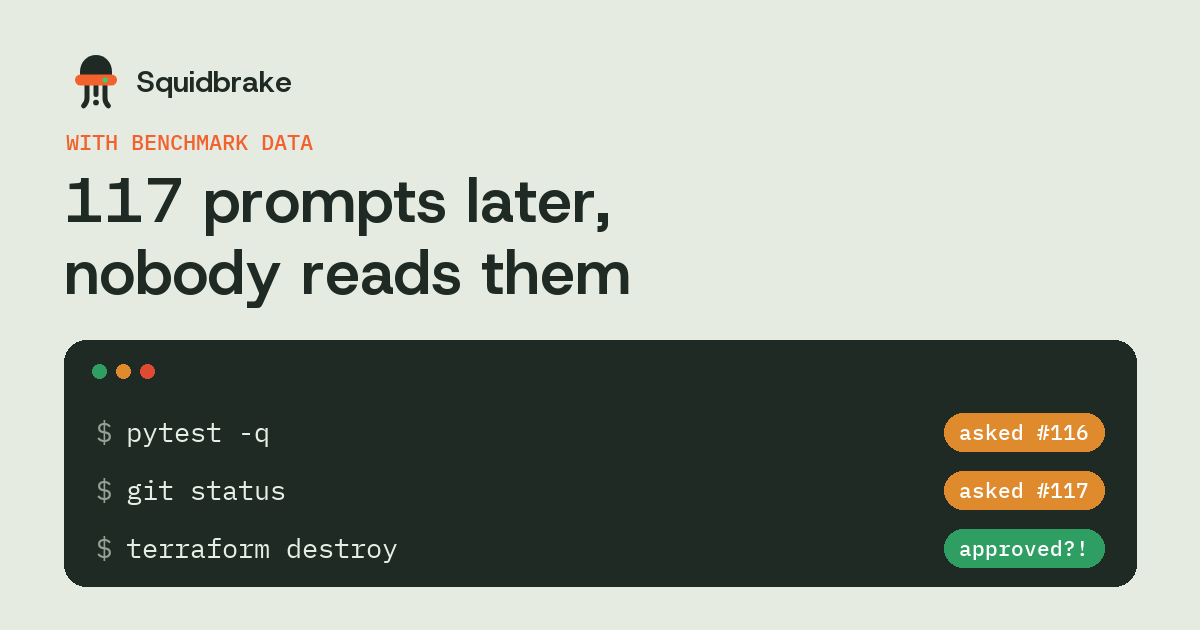
The safest-sounding setting for an AI agent is to ask before everything. In practice, people who are asked a hundred times stop reading at about the tenth, and the one prompt that mattered gets the same reflex yes as the rest. We measured it.
In short
- In our session benchmark, "ask for everything" asked a person 117 times and held 40 of 41 routine steps.
- Checking whole sessions stopped 68 of 71 harmful steps and held only 3 routine ones.
- Ask only about what can't be undone, show the effect rather than the raw command, and look at the session, not one step.
- Fewer, better questions are what keep the yes meaningful.
The numbers
We ran 66 agent sessions, 118 steps in all, through five approaches. Each step was labeled before any approach saw it: harmful, routine, or sensitive (legitimate, but a person should agree). Full method on the benchmark page.
| Approach | Harmful steps stopped | Routine steps held | Times a person was asked |
|---|---|---|---|
| Auto-run (no checks) | 0 / 71 | 0 / 41 | 0 |
| Ask for everything | 69 / 71 | 40 / 41 | 117 |
| Allowlist of common dev tools | 55 / 71 | 10 / 41 | 71 |
| Squidbrake, whole session | 68 / 71 | 3 / 41 | 72 |
Asking for everything stops about as much harm on paper, because the benchmark plays a perfect approver who says no to every harmful step. Real approvers aren't perfect, least of all on the 117th prompt.
Why people stop reading
When almost every prompt is harmless, saying yes stops being a decision. The prompt that matters, a terraform destroy or a push to main, arrives looking exactly like the forty pytest runs before it. The approval exists, the attention doesn't.
What to ask about instead
- Only what can't be undone. Reads, tests, builds and edits to tracked files can be undone or rerun. Deletes outside the project, force pushes, deploys, payments, production writes and outbound messages can't.
- Show the effect, not the call. "Deletes 3 volumes in production" gets read. A 300-character JSON payload doesn't.
- Look at the session, not the step. A
curlis routine. Acurlthat sends your config to an address a web page gave the agent is not. Only the session shows the difference. - Send it to the right person. The person running the agent wants it to finish. For production, a second person is a better check.
How Squidbrake asks
Squidbrake lets everyday coding work run on its own and holds only what can't be undone. An approval reaches a phone, Slack, Teams or email as a short card: what the action does, why it's held, and what the agent read before it. In the benchmark that's 3 routine steps held out of 41, against 40 for asking about everything.
Start in shadow mode to see what it would hold on your own agents before anything waits.
FAQ
What is approval fatigue?
When people are asked to approve too many actions, they stop reading and approve by reflex, so the approvals that matter get the same quick yes as the routine ones.
Should an AI agent ask before every command?
No. In our benchmark that asked a person 117 times and held 40 of 41 routine steps. Ask only about actions that can't be undone.
How do you reduce approval fatigue for AI agents?
Let undoable work run, hold only irreversible actions, describe each held action by its effect, and judge steps in the context of the whole session.
Is a classifier better than asking?
It removes most prompts, but it's a judgement that can miss. For the few irreversible actions, a fixed rule that waits for a person is more predictable.
Try it on your own agents. pipx install squidbrake, then
squidbrake connect all. Start in shadow mode: nothing is blocked in week one, you see what would have been.
Quickstart · Benchmark · Book a demo