AI agent governance: a practical framework for teams putting agents in production
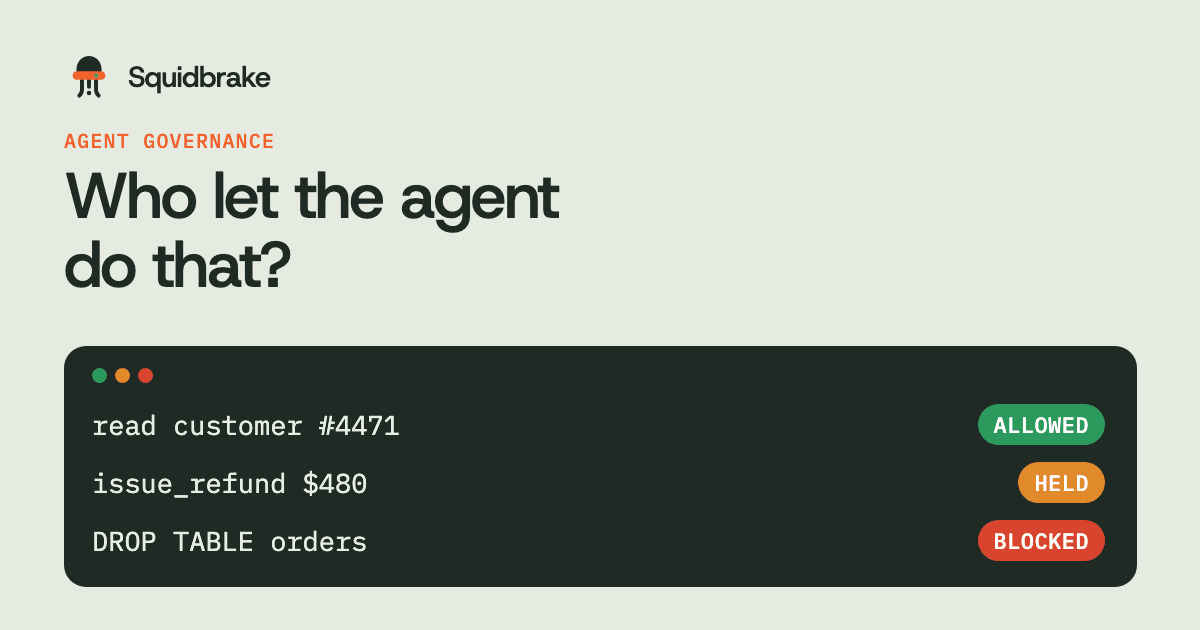
AI governance used to mean model cards and bias reviews. Agents changed the question. When software can delete a database, push to main or issue a refund on its own, governance is about actions: who may do what, who signs off, and how you prove it afterwards. This is a framework you can put in place this quarter, with seven controls in the order we'd add them.
In short
- AI agent governance is about what agents do, not only what models say.
- Seven controls: inventory, identity, least privilege, approval tiers, a kill switch, an audit trail and a weekly review.
- Rules that decide must run outside the agent: an instruction in a prompt is not a control.
- Start in observe mode for a week, then enforce the rules that proved accurate.
What AI agent governance means
AI agent governance is the set of policies and technical controls that decide what autonomous AI agents may do, who approves their risky actions, and how every action is recorded. It covers coding agents such as Claude Code, Cursor and Codex, and business agents that handle support tickets, refunds or data changes.
It differs from model governance in one way that matters: a chatbot's worst output is a wrong answer a person can ignore. An agent's worst output is a command that already ran. So the controls have to sit before the action, and they have to work even when the agent is confidently wrong.
The seven controls
- Inventory every agent and its tools. List each agent, who owns it, which tools and MCP servers it can call, and which systems those reach. Most teams find agents nobody approved: a personal Cursor install, an n8n workflow, a script with an API key.
- Give each agent an identity and an owner. An agent acts for a person or a team. Its credentials should say which, so the record shows "Priya's Claude Code" and not "the shared deploy key".
- Apply least privilege. Scope tokens to what the job needs, keep production credentials off developer machines, and remove MCP servers nobody uses. See least privilege for AI agents.
- Sort actions into three tiers. Routine actions run and are recorded. Risky ones wait for a person who isn't the one who asked. Catastrophic ones are blocked. The table below is a starting point.
- Have a kill switch and spend limits. Be able to stop one agent, one conversation, or all of them, from somewhere the agent can't reach. See AI agent kill switch.
- Keep an audit trail someone outside engineering can read. Who asked, what ran, which rule decided, who approved and when. Make it tamper-evident. See audit trails for AI agents.
- Review it every week. Look at what was held, what was blocked, and what was held that shouldn't have been. A rule that holds routine work trains people to click "approve" without reading.
A starting set of approval tiers
| Tier | Examples | What happens |
|---|---|---|
| Runs | Reading code, running tests, editing files in the repo, commits to the agent's own branch, read-only queries | Runs on its own and is recorded |
| Held | Pushing to main, terraform apply, deleting data, refunds and payouts, sending data to an address only outside content mentioned | A second person sees what it will change and approves or rejects |
| Blocked | rm -rf ~/, wiping a drive, disabling backups and then deleting the database, an agent switching off its own controls | Never runs |
Keep the held tier small. In our approval fatigue benchmark, asking about every action held 40 of 41 routine steps; judging whole sessions held 3.
Who owns AI agent governance
- Engineering owns the agents, their credentials and the rules for its own systems.
- Security owns the policy floor (what is always blocked), the kill switch and the review of near misses.
- Compliance or risk owns the evidence: who approved what, kept in a form an auditor can check.
- Finance and operations approve the actions that are theirs, such as refunds and payouts, not engineering.
How it maps to the frameworks you already use
- OWASP LLM06 (excessive agency) and the OWASP Top 10 for Agentic Applications: least privilege, human approval for high-impact actions, controls outside the model.
- SOC 2 CC8.1: changes are authorised, tested and approved. An agent's change to production is still a change. See SOC 2 for AI agents.
- ISO 27001 A.8.32 (change management) and A.8.15 (logging).
- NIST AI RMF: its Govern, Map, Measure and Manage functions map to ownership, inventory, review and controls above.
- EU AI Act Articles 12 and 14 (record-keeping and human oversight) for high-risk systems, with stand-alone high-risk duties now due from December 2027. See Article 14 for agents.
Putting the framework in place with Squidbrake
Squidbrake is open-source change control for AI agents. It checks every action an agent takes, before it runs, against one policy for every agent you run: Claude Code, Cursor, Codex, Gemini CLI, VS Code Copilot, any MCP server, and your own agents through Python or HTTP. Decisions come from rules, not an LLM.
- Controls 4 to 6 are built in: allow, hold for a second person (dashboard, phone, Slack, Teams or email), or block; a kill switch and spend limits; a hash-chained, tamper-evident record with an evidence pack for auditors.
- Control 7 is
squidbrake report --week: held, blocked, would-have, and the false-positive rate per rule. - Start in observe mode: nothing is blocked in week one, you see what would have been.
FAQ
What is AI agent governance?
The policies and technical controls that decide what autonomous AI agents may do, who approves their risky actions, and how each action is recorded. It applies to coding agents and to business agents that change data or move money.
How is AI agent governance different from AI governance?
AI governance usually covers models: data, bias, accuracy and documentation. Agent governance adds actions: permissions, approvals before risky changes, a kill switch and an audit trail of what the agent actually did.
What is the first step in governing AI agents?
An inventory: every agent in use, who owns it, and which tools, credentials and systems it can reach. You can't set rules for agents you don't know about.
Can we govern agents with instructions in the system prompt?
No. An instruction is a request the agent can ignore or misread, as the Replit code-freeze incident showed. Controls that decide must run outside the agent, before the action.
Try it on your own agents. pipx install squidbrake, then
squidbrake connect all. Start in shadow mode: nothing is blocked in week one, you see what would have been.
Quickstart · Benchmark · Book a demo